Philosophy in your hands
Philosophy that argues back.
Real philosophical problems, told as stories you can read with half your attention. Take a side and the other mind argues back at full strength, three levels deep. Hold your ground, or move.



Ten challenges free, and a new one every day. For iPhone®, iPad® and Android.
- A broken leg kept a boy out of a war. Was the day it broke a bad day?
- Was seven prime before there was anyone to count?
- Can seeing red teach someone who already knows all the science?
- Does doing wrong harm the man who gets away with it?
- Not one plank from the first voyage is left. Is it still the same ship?
- Not a stroke changed when the forgery came out. Is it worth less as a painting?
- One city lives well because a child suffers. The other has less and spares the child. Which was better?
- Singing means no more to her than silence. Could an endless life still be good for her?
- Two drivers skipped the same brake check. Only one of them killed a child. Does the driver who killed deserve more blame?
- The captain believed the death sentence was unjust. Did the law still give him a duty to carry it out?
How a puzzle runs
One problem, argued properly from both sides.
-
Read the story
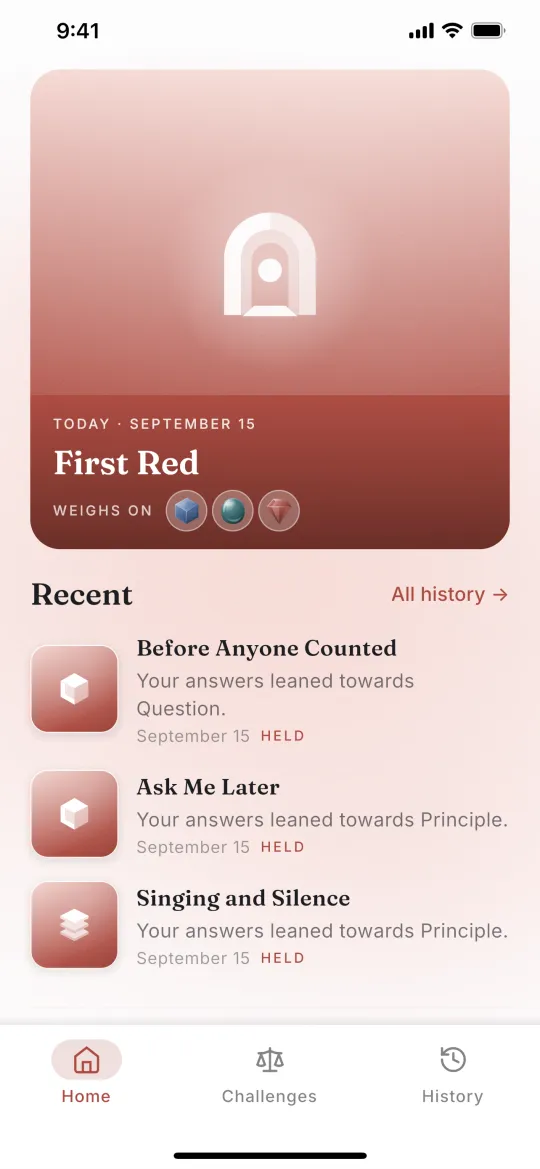
Every challenge opens on a real problem from the history of philosophy, told as a case you can picture. A ship repaired plank by plank until none of the first wood is left. A forged Vermeer that fooled a leading authority on Dutch painting. A city that lives well because a child suffers.
-
Take a side
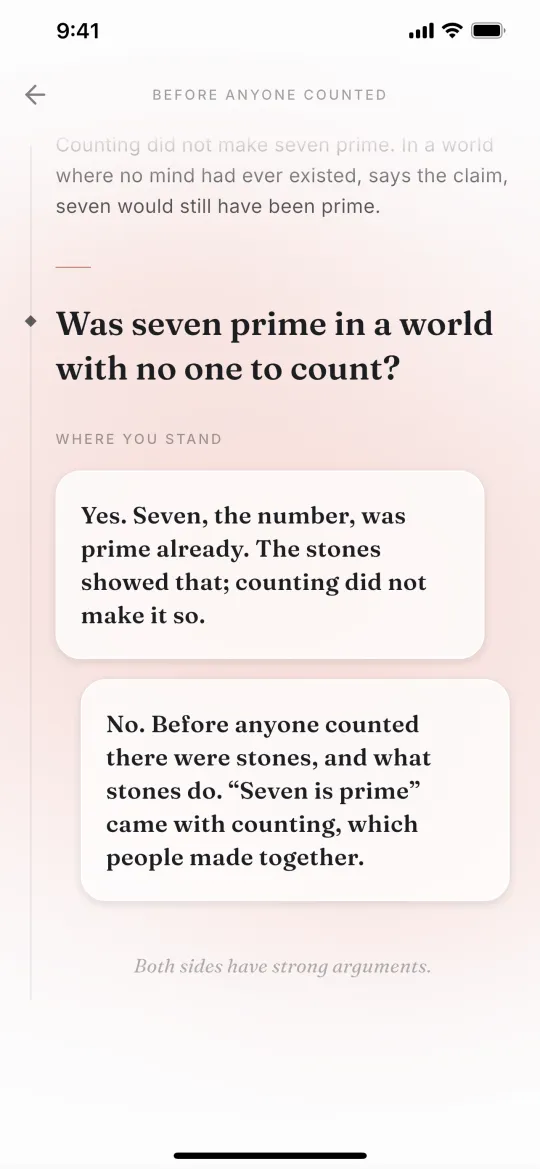
Two answers, and serious people hold each of them. Tap the one you believe and a pen strikes through the other. Nothing is marked right.
-
Meet the other mind
The moment you choose, the other side makes its case against you at full strength. Then it's your call. Take it back, or hold your ground: press HOLD for three full seconds, the way the app asks you to. Go on, try it.
Your phone ticks under your thumb, with a heavier beat each second.
-
Go three levels deep
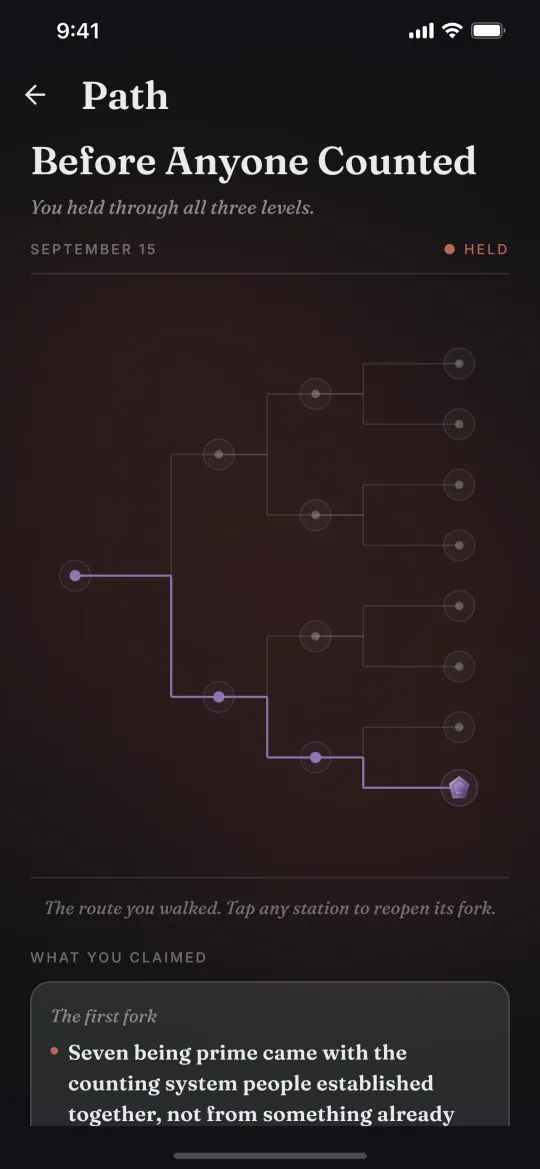
Each answer opens a new situation that asks what your last one commits you to, and what it will cost you. Seven questions, fourteen answers, eight routes. Afterwards, the record shows the road you took and the ones you didn't.
-
See where you lean
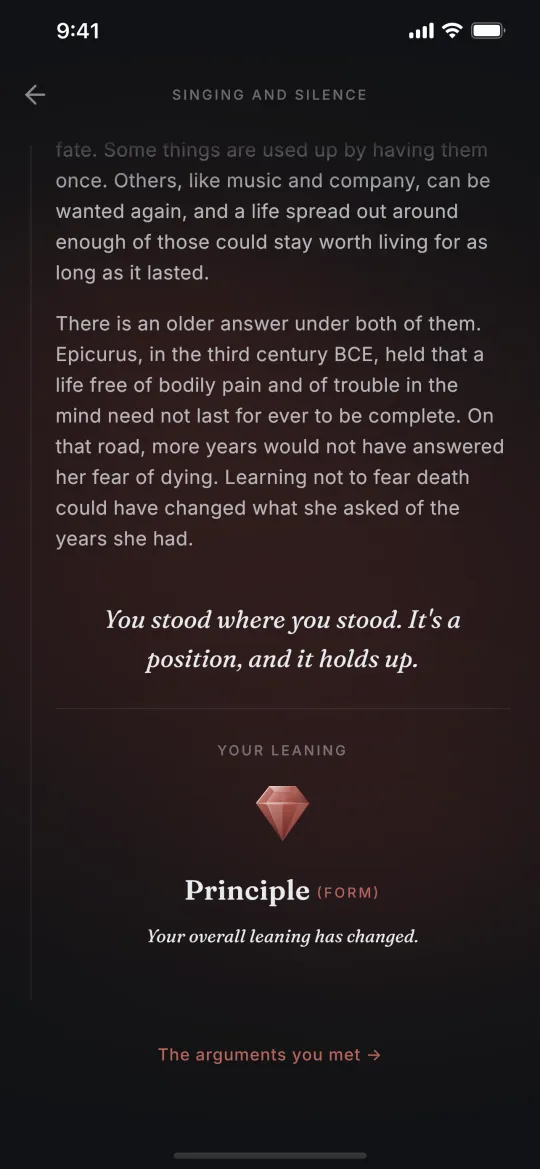
The close tells you what philosophers have argued about the question, then shows the temperament your answers leaned toward. No score, no verdict. The app's own colours become what you argued.
Six temperaments
Six ways a mind can lean.
Every answer leans toward one or two of six philosophical temperaments. Lean on one enough and it becomes the colour of the app, from the full stop in its name to the light behind every page. Try one on.
House rules
The rules it keeps.
No score, no verdict.
Where you lean shows up as colour, never as a grade. No answer is marked correct.
Both sides are strong.
Every fork has serious arguments on both sides, and the other mind always argues the one you didn't take.
Real problems, retold.
Each challenge is a recognised problem from the history of philosophy, dramatised as a story. Never trivia.
Sources you can check.
Every challenge closes with the books and papers behind its arguments, with notes and links to read further.
No account needed.
Your answers stay on your device. Sign in only if you want your record on another one.
No ads.
And 2 Minds never asks to track you across other companies' apps and websites.
Built for RevenueCat Shipaton 2026
One developer, one Kotlin codebase, three stores.
2 Minds is written in Kotlin Multiplatform and Compose Multiplatform. Every screen designed for it, the motion, the database, sync and billing are shared Kotlin, running on iPhone, iPad, Android phones, tablets and foldables.
- 97%
- of the source lines are shared Kotlin
- 7
- Swift files in the whole app
- 3
- stores: App Store®, Google Play, Galaxy Store
- 6
- theme reveals, one for each temperament
Your first argument is waiting.
Ten challenges free, and a new one every day. 2 Minds Premium opens the whole library.
Help and questions: support@2minds.app